Switching Frequencies: How Working Both Sides of the Lens Made Scott Alan Ciolek a Sharper Creative
Most people in entertainment plant a flag in one territory and stay there. It's safer that way. You build a reputation, you refine a niche, and you let the work come to you. Scott Alan Ciolek never really saw the point in that. Digging deep into both audio production and on-camera performance hasn't just broadened his résumé — it's fundamentally rewired the way he approaches every single project, no matter which chair he's sitting in that day.
That's not a small thing in a landscape as competitive and specialized as American entertainment. The US media industry rewards depth, sure, but it increasingly demands range. Understanding how those two disciplines actually talk to each other — technically and artistically — is where Scott's career starts to get genuinely interesting.
The Invisible Architecture of Sound
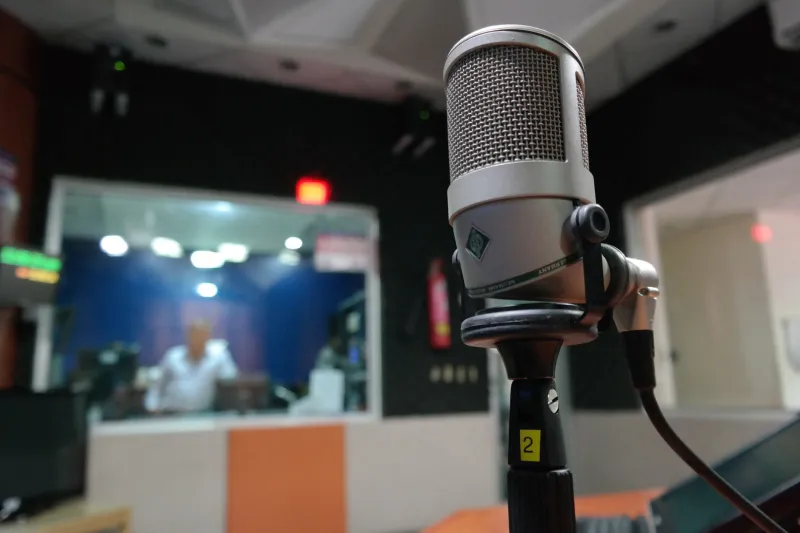
Let's start with audio, because that's where a lot of people underestimate what's really happening. When you step into a production role behind the mic — whether that's voiceover, podcast hosting, audio direction, or any number of other formats — you're not just talking. You're thinking architecturally. Every pause, every breath, every shift in tone is a structural decision. You're building something the listener can't see, which means the sound itself has to carry all the emotional weight.
Scott has talked about how audio work demands a specific kind of internal discipline. There's no camera to cut away to, no visual context to bail you out if your delivery goes flat. You either hold the listener's attention through pure craft, or you lose them. That pressure sharpens you in ways that are hard to replicate in any other medium. You become hyper-aware of pacing, of the rhythm inside a sentence, of how much silence can actually say.
For anyone who's spent serious time in audio production in the US — where podcast culture alone has exploded into a multi-billion-dollar industry — that training is invaluable. It teaches restraint. It teaches economy. And those lessons don't stay locked in the recording booth.
When the Camera Turns On
Here's where things get interesting. Bring that audio-trained sensibility onto a set — put Scott in front of a camera — and something shifts. The instincts he's built around vocal precision and internal pacing don't disappear. They translate. They show up as a kind of groundedness that you can actually see on screen, even if you can't quite name what you're looking at.
On-camera work introduces a whole new layer of technical demands. Now there's lighting to consider, eyeline, physical stillness versus intentional movement, the relationship between what the face is doing and what the body is doing. A camera is ruthlessly honest. It catches everything — the micro-expressions, the tension in a jaw, the slight disconnect between what someone is saying and what they actually mean. Learning to be comfortable under that scrutiny is its own discipline entirely.
But here's what Scott brings to it that a purely on-camera performer might not: he already knows how to listen from the inside out. Audio work trains you to monitor yourself in real time, to make adjustments mid-performance without breaking the flow. On camera, that skill becomes something closer to a superpower. He's not just performing — he's calibrating, constantly, in a way that reads as natural rather than calculated.
The Mindset Shift Between Mediums
One of the more underrated aspects of working across both disciplines is knowing when to flip the internal switch. It's not automatic, and it's not instant. Walking into a recording session requires a different mental posture than walking onto a set, and conflating the two is a real trap that catches people.
In audio, the mindset is inward. You're focused, contained, almost meditative. The performance lives in a very specific, controlled space. Everything external — the room, the equipment, the producer in your ear — feeds into that interior process.
On camera, the energy is more expansive. You have to fill space differently. You're in conversation with a physical environment, with other performers, with a crew of people whose work directly intersects with yours. The mindset is outward, relational, responsive. You're not just delivering — you're inhabiting.
Scott has developed a kind of mental pre-flight checklist, an almost ritualistic way of orienting himself before stepping into either mode. It's the kind of thing that comes from doing the work long enough to recognize what your brain actually needs before it can perform well. That level of self-awareness is something most people in entertainment only develop after years of hard-won experience.
Why the Cross-Training Actually Matters
There's a practical argument here that goes beyond personal artistry. In today's US entertainment market, productions are leaner, timelines are tighter, and the people who can move fluidly between roles are simply more valuable. A talent who understands the technical side of audio doesn't just perform better in audio settings — they communicate better with engineers, they make smarter choices in post, they understand why certain decisions are being made on the fly.
Similarly, someone who's been in front of a camera understands what a director actually needs from a performance. They know what cuts well, what doesn't, and why the same line delivered two different ways can mean the difference between a scene that works and one that doesn't.
That cross-disciplinary fluency makes collaboration smoother. It makes problem-solving faster. And in a business where time genuinely is money, that's not a soft skill — it's a competitive advantage.
The Bigger Picture
What Scott Alan Ciolek has built across his career isn't just a list of credits in two different categories. It's a creative identity that's genuinely hard to replicate, because it was built through sustained, serious engagement with both disciplines — not dabbling, not résumé-padding, but actual mastery pursued in parallel.
The entertainment industry in America has always celebrated the multi-hyphenate, the writer-director, the actor-producer, the performer who can do more than one thing well. What's less commonly celebrated — but maybe more rare — is the person who's developed a technical and artistic fluency across mediums that makes each one better because of the other.
That's the through-line in Scott's work. It's not about being everywhere at once. It's about understanding, at a deep level, how different creative disciplines actually speak to each other — and using that understanding to make the work sharper, more honest, and more resonant every single time.